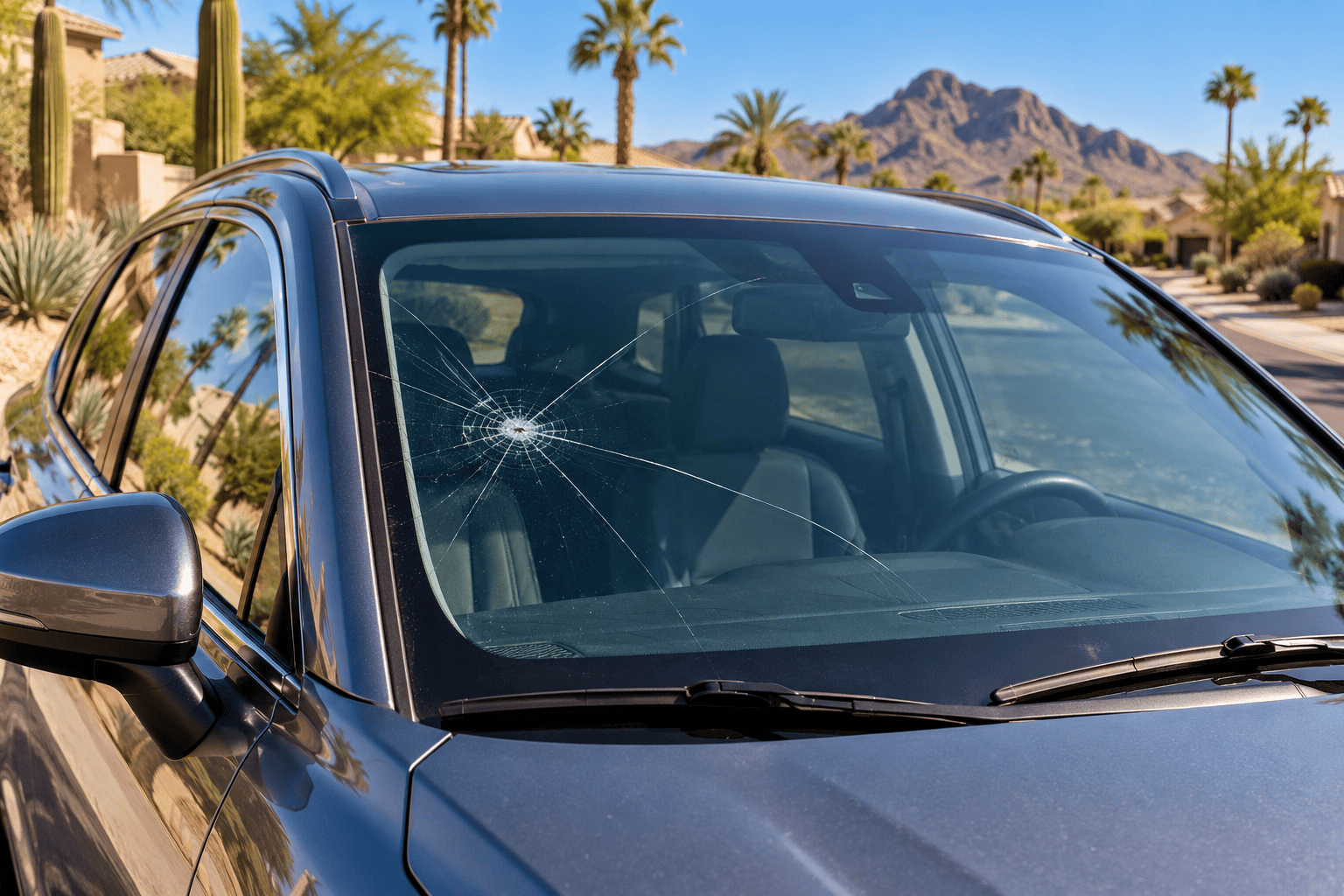
A small chip in your windshield can be easy to ignore, especially when you are rushing to work or heading across the Valley. However, Phoenix drivers have another factor to consider: extreme desert heat can put additional stress on already damaged auto glass. Sometimes a minor chip can be repaired, while more serious damage may require professional windshield replacement in Phoenix to restore clear visibility and properly address the damaged glass.
The tricky part is knowing where that line is.
A tiny mark caused by a stone on I-10 may look harmless today, but vibration, another impact, or repeated temperature changes can cause the damage to spread. A crack can also create glare, interfere with your view of traffic, and affect parts of the windshield that play a larger role in your vehicle than many drivers realize.
Here is what Phoenix drivers should know about driving with a cracked windshield, what makes cracks spread, and when repair may no longer be enough.
Is It Safe to Drive With a Cracked Windshield?
There is no single answer for every cracked windshield. The safety concern depends on several factors, including:
- How large the crack is
- Where the crack is located
- Whether it is spreading
- How deep the damage goes
- Whether there are multiple cracks or impact points
- Whether the driver’s view is affected
A small chip near the passenger side of the windshield is different from a long crack running directly through the driver’s field of vision. However, even damage that seems minor should not automatically be ignored.
Windshield cracks can change. What starts as a small problem may spread across the glass after driving over rough pavement, hitting a pothole, slamming a door, or exposing a hot windshield to rapid cooling.
How a Crack Can Affect Your Visibility
Your windshield should give you a clear, undistorted view of traffic, pedestrians, cyclists, road signs, and changing road conditions.
A crack can interfere with that view in several ways.
Sunlight can reflect off the edges of damaged glass and create glare. That can be especially distracting during a Phoenix sunrise or late afternoon when the sun sits low in the sky. Headlights at night can cause similar reflections.
Cracks can also distort objects viewed through damaged areas of the glass.
The problem becomes more serious when the damage is directly in front of the driver. Even if you can technically see through it, your eyes may constantly refocus around the crack.
Clear visibility becomes even more important during unusual Arizona weather. Heavy rain during monsoon season can reduce visibility quickly. Windshield damage, worn wipers, water, and glare together can make it harder to see the road.
For more general wet-weather preparation, County Auto Parts also has a guide to driving safely in the rain.
How a Damaged Windshield Can Lose Strength
A windshield does more than keep wind, insects, dust, and road debris out of your face.
Modern automotive windshields are made from laminated safety glass. The layers are designed to remain together when damaged rather than breaking apart like ordinary household glass.
A crack means part of that glass structure has already been compromised.
That does not mean a small crack will suddenly cause the windshield to collapse. However, existing damage creates a weak point that can respond differently to vibration, pressure, temperature changes, or another impact.
That is one reason it makes sense to have windshield damage evaluated while it is still relatively small.
What Causes a Cracked Windshield?
Sometimes the cause is obvious. You hear a stone hit the windshield and immediately notice a chip.
Other times, you may walk out to your car and discover a crack that appears much larger than the damage you remember seeing the day before.
Several situations commonly contribute to windshield damage.
Rocks and Road Debris
Loose stones are among the most familiar causes of windshield chips.
A vehicle ahead of you may kick up a small stone that strikes the windshield at highway speed. Construction vehicles, gravel trucks, roadwork, and debris along busy roads can also increase the chance of an impact.
Phoenix-area drivers spend plenty of time on roads such as I-10, I-17, Loop 101, Loop 202, and US 60. At highway speeds, even a relatively small object can hit the glass with considerable force.
The result may be:
- A small pit
- A bull’s-eye chip
- A star-shaped break
- A short crack
- Several lines radiating away from one impact point
Do not assume that damage is harmless just because it is small immediately after the impact.
Sudden Temperature Changes
Glass responds to changes in temperature by expanding and contracting.
That matters more when the windshield already contains a weak point.
Imagine parking outdoors in Phoenix for several hours on a summer afternoon. The windshield becomes very hot. You get in, turn the air conditioning to maximum, and direct cold air toward the glass.
That sudden temperature difference creates additional stress.
A healthy windshield is designed to handle normal driving conditions, but an existing chip or crack can make the glass more vulnerable.
Extreme Heat and Sun Exposure
Heat by itself does not mean your windshield will suddenly crack. Cars in Arizona are designed to operate in hot climates.
The concern is existing damage.
A windshield sitting in direct sunlight can become extremely hot. Different sections of the glass may also heat and cool at different rates, particularly when part of the windshield is shaded.
If a chip is already present, repeated heating and cooling can place additional stress around it.
Phoenix drivers can reduce unnecessary temperature stress by parking in a garage, under covered parking, or in shade when practical.
Accidents and Minor Impacts
You do not need to be involved in a major collision to damage a windshield.
A relatively minor accident may place stress on the glass or windshield frame. The first thing most drivers notice after a collision is usually bumper damage, a dent, or broken lights, so windshield damage can sometimes receive less attention.
If your vehicle was recently involved in a collision, review County Auto Parts’ guide to the signs you may need windshield replacement after an accident in Phoenix.
Other impacts can include:
- Falling branches
- Hail
- Objects falling in a garage
- Debris thrown by another vehicle
- Construction materials
- Accidental impacts during vehicle maintenance
Inspect the entire windshield after any significant impact, not just the point where you think the object struck.
Installation Problems or Existing Glass Stress
Occasionally, windshield problems may be related to previous installation, damage around the glass, or stress affecting the windshield.
This is not something a driver can reliably diagnose just by looking at the crack.
If damage appears without an obvious impact, a professional inspection can help determine what is happening.
Why Windshield Cracks Get Bigger
One of the biggest reasons to deal with windshield damage early is simple: cracks do not always remain the same size.
Several everyday situations can make existing damage worse.
Vehicle Vibration
Every time you drive, your vehicle experiences vibration.
Most of it is normal and harmless. But damaged glass already contains a weak point.
Driving over:
- Potholes
- Rough pavement
- Speed bumps
- Uneven construction zones
- Railroad crossings
can place additional stress on an existing crack.
You do not have to be driving aggressively for this to happen. Regular commuting can be enough for some damaged areas to gradually spread.
Heat and Cold
Temperature changes can repeatedly expand and contract the windshield.
Phoenix makes this particularly relevant because drivers can move between very hot outdoor temperatures and aggressively air-conditioned environments several times in one day.
The safest approach is not to panic about temperature changes. Instead, recognize that an existing chip deserves attention before repeated stress turns it into something larger.
Moisture and Dirt
A chip is an opening in the otherwise smooth surface of the windshield.
Dust, road grime, water, and other contaminants can collect inside that damaged area.
Phoenix is certainly no stranger to dust. Between normal desert conditions, wind, construction, and dust storms, vehicles can accumulate fine particles quickly.
Keeping damaged glass reasonably clean can help, but cleaning does not repair the damage.
Another Road Impact
A second stone does not have to hit exactly where the first one did.
Once a windshield already has damage, another impact can add stress elsewhere in the glass. Multiple chips and cracks can also make eventual repair more complicated.
Can a Cracked Windshield Be Repaired?
Sometimes.
A cracked windshield does not automatically mean the entire piece of glass must be replaced.
Professional windshield repair techniques can address certain types of minor damage by filling the damaged area with specialized resin. Whether that is appropriate depends on the specific windshield.
Factors include the size, location, depth, age, and type of damage.
Damage That May Be Repairable
A technician may be able to repair damage such as:
- A small rock chip
- A limited impact point
- A short crack
- Damage away from the windshield edge
- Damage outside the driver’s primary field of vision
- Damage that has not seriously compromised multiple layers
These are general examples rather than universal rules.
Different windshield designs and different types of damage may require different solutions.
Why Early Repair Matters
There is a major advantage to having a chip inspected before it becomes a long crack: you may still have more repair options available.
Once damage spreads substantially, repairing only the original impact point is no longer enough.
Early attention can also prevent dirt from becoming deeply embedded in the damaged area.
If you hear a rock strike the windshield and notice a fresh chip, it is worth addressing it sooner rather than waiting several months to see what happens.
When Does a Windshield Need to Be Replaced?
There are situations where repairing one small section of the windshield may no longer be appropriate.
A professional should make the final determination, but several warning signs suggest replacement may need to be considered.
The Crack Is Long or Continues to Spread
A crack extending across a significant portion of the windshield is very different from a tiny surface chip.
If you mark the end of a crack and notice that it continues moving over the following days, the damage is actively spreading.
At that point, delaying an inspection can allow the problem to become more extensive.
The Damage Is in the Driver’s Line of Sight
Damage directly in front of the driver deserves additional attention.
Even a repair can sometimes leave a visible mark or slight optical difference in the glass. If that remaining mark would interfere with the driver’s view, replacement may be a more suitable solution.
The goal is not simply to make the windshield look better. The driver needs a consistently clear view of the road.
The Crack Reaches the Edge of the Windshield
The outer edges of a windshield are important because that is where the glass is bonded to the vehicle.
Damage reaching this area may be treated more cautiously than a small isolated chip near the centre of the glass.
If a crack is touching or approaching the edge, schedule an inspection rather than continuing to monitor it indefinitely.
There Are Several Chips or Cracks
One repairable chip is one thing.
A windshield with several impact points, branching cracks, or widespread damage presents a different problem.
At some point, trying to repair multiple areas may no longer make sense compared with replacing the damaged windshield.
The Glass Has Deep or Complex Damage
Some impact patterns are more complicated than a simple chip.
Watch for:
- Long branching cracks
- Multiple cracks from one impact
- Crushed glass around the impact point
- Large star patterns
- Damage affecting more than the outer surface
- Areas where glass appears heavily fractured
These should be professionally evaluated.
Why Windshield Condition Matters for Modern Vehicle Safety Systems
Windshield replacement has become more complicated as vehicles have added advanced driver-assistance systems.
Many newer cars, trucks, and SUVs have forward-facing cameras mounted near the top centre of the windshield.
Depending on the vehicle, these cameras may support functions such as:
- Lane departure warnings
- Lane keeping assistance
- Forward collision warnings
- Automatic emergency braking
- Traffic sign recognition
- Adaptive cruise control
Replacing the windshield can change the camera’s position relative to the road.
Some vehicles therefore require calibration after windshield replacement so the camera and related systems operate according to the manufacturer’s specifications. Preferred Auto Glass lists ADAS calibration among its Phoenix windshield services.
If your vehicle has windshield-mounted cameras or sensors, ask about calibration requirements before replacement.
What Should You Do If Your Windshield Cracks While Driving?
Hearing a loud pop from the windshield while travelling down the freeway can be startling.
If it happens, concentrate on driving first.
Stay Calm and Check Your Visibility
Do not suddenly brake simply because a stone hit your windshield.
Keep control of the vehicle and check whether the damage has obstructed your view.
If the windshield is badly damaged or visibility has become unsafe, move toward a safe location and pull over when conditions allow.
Do Not Press on the Crack
It can be tempting to touch the area to see how deep it is.
Avoid applying pressure to damaged glass.
You can inspect it visually once the vehicle is safely parked.
Avoid Extreme Temperature Changes
You do not need to turn your air conditioner off completely in Phoenix heat.
Instead, avoid unnecessarily blasting extremely cold air directly onto a very hot section of damaged windshield glass.
Allowing the cabin and glass to cool somewhat more gradually can reduce unnecessary temperature stress.
Arrange an Inspection
Once you are safely parked, look at:
- The approximate length of the crack
- Where it begins and ends
- Whether it reaches an edge
- Whether it blocks your view
- Whether multiple impact lines are present
Photos can also help you track whether the crack changes before your appointment.
Then have an auto glass professional determine whether repair or replacement is appropriate.
Can You Stop a Windshield Crack From Spreading?
There is no dependable home trick that turns a cracked windshield back into undamaged glass.
Temporary precautions may reduce additional stress, but they are not replacements for professional repair.
Until the windshield is inspected:
- Avoid rough roads when reasonable.
- Do not slam vehicle doors.
- Avoid putting unnecessary pressure on the glass.
- Park under cover or in shade when available.
- Avoid dramatic temperature changes.
- Keep the damaged area reasonably clean.
- Schedule professional assessment promptly.
Be particularly cautious about DIY windshield products marketed as permanent solutions.
Some repair kits may be intended for minor chips, but attempting to fix significant damage yourself can make later professional repair more difficult.
Windshield Damage in Phoenix’s Hot Climate
Phoenix vehicles live in a demanding environment.
For much of the year, cars spend hours sitting under intense sunlight. Then we climb inside, start the engine, and turn the air conditioning up as quickly as possible.
Add freeway driving, road construction, desert dust, loose rocks, and occasional monsoon weather, and windshields see plenty of daily stress.
That does not mean Phoenix drivers need to replace their windshields every time they notice a tiny mark.
It means damage should be evaluated based on its condition instead of ignored simply because the car is still drivable.
A small chip may still be repairable. A long crack across the driver’s view is a different situation.
When damage is severe enough that repair is no longer appropriate, using a professional service for windshield replacement in Phoenix can help restore proper visibility and ensure the new windshield is installed for the specific vehicle.
Windshield Repair or Replacement? A Quick Comparison
The following table gives a general idea of how different types of damage may be approached.
| Windshield Condition | Repair May Be Possible | Replacement May Be Needed |
|---|---|---|
| Small isolated rock chip | Often | Sometimes |
| Short crack | Possibly | If spreading or unsuitable for repair |
| Damage directly in driver’s view | Less likely | Often |
| Crack reaching the windshield edge | Less likely | Often |
| Multiple cracks | Sometimes | Often |
| Deep or complex impact damage | Less likely | Usually |
| Large spreading crack | Unlikely | Usually |
| Shattered windshield | No | Yes |
This is only a general comparison. A qualified auto glass technician should inspect the windshield before determining the appropriate option.
Frequently Asked Questions About Cracked Windshields
Can I Keep Driving With a Small Windshield Crack?
Possibly, but the important question is not simply whether the vehicle still moves safely down the road.
Consider where the crack is located, whether your visibility is affected, and whether the damage is spreading.
Even a small crack deserves an inspection because waiting can turn repairable damage into a larger problem.
How Quickly Can a Windshield Crack Spread?
There is no standard timeline.
One crack may remain almost unchanged for weeks, while another can grow noticeably after a temperature change, pothole, highway trip, or additional impact.
That unpredictability is one reason it is better to address chips and cracks early.
Can Phoenix Heat Make a Windshield Crack Worse?
Heat can place additional stress on already damaged glass, particularly when the windshield experiences uneven or rapid temperature changes.
Phoenix drivers should pay particular attention to existing chips during hot weather rather than assuming the damage will remain unchanged.
Can a Long Windshield Crack Be Repaired?
Sometimes repair technology can address cracks that drivers might assume are too large, but long or complex cracks are generally more difficult to repair than small chips.
Location and depth matter too.
Have a professional inspect it instead of relying only on the length.
Should I Replace a Windshield if the Crack Is in Front of Me?
Damage in the driver’s primary viewing area deserves prompt professional assessment.
Anything that causes distortion, glare, or a persistent obstruction can interfere with your ability to monitor traffic and road hazards.
Replacement may be recommended when repair cannot provide acceptable visibility.
Does a New Windshield Need ADAS Calibration?
It depends on the vehicle.
If a camera or sensor associated with an advanced driver-assistance system is mounted to or positioned through the windshield, calibration may be required after the glass is replaced.
Always follow the vehicle manufacturer’s requirements and ask the installer whether calibration applies to your model.
Do Not Ignore a Cracked Windshield
It is easy to postpone windshield repair when the car still drives normally.
A chip does not make engine noise. A crack does not necessarily trigger a dashboard warning. You may be able to drive around Phoenix for days without noticing any obvious change.
That does not mean the damage should stay at the bottom of your maintenance list.
Check where the damage is located, watch for spreading, and pay particular attention to cracks that affect your view or reach the edge of the windshield. Remember that Phoenix heat, freeway vibration, rough pavement, and another impact can add stress to glass that is already damaged.
Small damage may still be repairable if you address it early. More extensive damage may require windshield replacement.
Either way, an inspection gives you a clearer answer than waiting for a small crack to decide for you.
Your windshield is one of the parts of your car that you look through every second you are driving. Keeping it clear and properly maintained is a simple part of making everyday trips around Phoenix safer and less stressful.